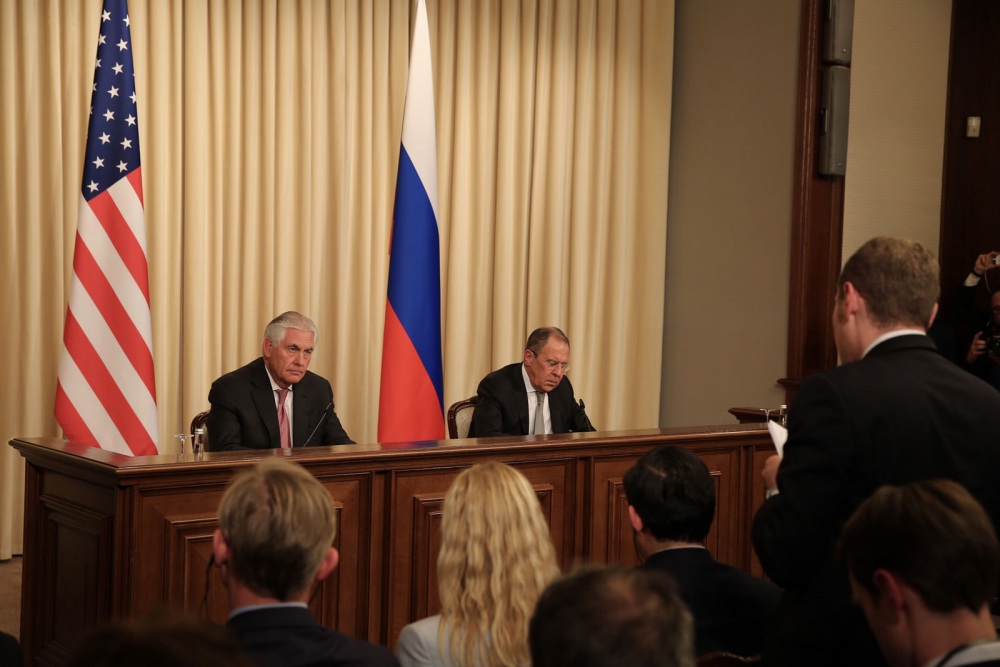
Resources on Russia
Resources on Russia’s nuclear program, disarmament treaties, and recommendations for preventing nuclear confrontation between Russia and the U.S.
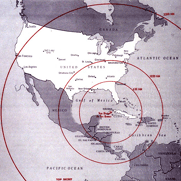
About the image
The Cuban Missile Crisis is history, but the nuclear threat is still with us, 50 years later.
Visit www.cubanmissilecrisisat50.org to find out why we should still be holding our breath.
For more information on the crisis, including its history, how it relates to today and pop culture representations, see below.
TODAY'S NUCLEAR THREAT
Twitter Q&A with NTI President Joan Rohlfing
Rohlfing will tackle questions on Wednesday, October 24 at 2PM EST on the 50th anniversary of the Cuban Missile Crisis and today's nuclear threats. Join in by tagging questions and comments with #MissileCrisis.
Understanding the Nuclear Threat: A Primer
The basics on the nuclear threat.
A Conversation with Senator Nunn at the World Affairs Council
Video of NTI Co-Chairman Sam Nunn talking with Phil Taubman, author of The Partnership.
THE DANGERS OF KEEPING WEAPONS ON HAIR-TRIGGER ALERT
NTI Fact Sheet: Building Global Security by Taking Nuclear Weapons off Hair-Trigger Alert
Background, FAQs and why the U.S. and Russia should take weapons off hair-trigger alert status.
“13 Minutes to Doomsday,” Washington Post editorial, July 8, 2012
“Today, the United States and Russia have as many as 1,800 warheads on alert at any given time. This is overkill and unnecessary so long after the Cold War has ended. We think that both countries should ease off the alert status for strategic forces.”
“US and Russia urged to slash nuclear arms,” Financial Times, May 15, 2012
General James Cartwright: “The current postures of launch-ready nuclear forces that provide minutes and seconds of warning and decision time should be replaced by postures that allow 24-72 hours on which to assess threats and exercise national direction over the employment of nuclear forces.”
"Modernizing U.S. Nuclear Strategy, Force Structure and Posture," a report from the Global Zero US Nuclear Commission (PDF)
"In our illustrative plan, the U.S. over the next ten (10) years reduces its arsenal to a maximum of 900 total nuclear weapons and increases the warning and decision time over its smaller arsenal."
"Reframing Nuclear De-Alert: Decreasing the Operational Readiness of U.S. and Russian Nuclear Arsenals," a report by the EastWest Institute (PDF)
"This report, which reflects the rich debate not only between the United States and Russia but also the views of other non-nuclear weapon states, elaborates on how the issue can be reframed. More importantly, it outlines a series of practical steps that the United States and Russia might consider."
THE CUBAN MISSILE CRISIS: HISTORY
www.cubanmissilecrisis.org
Extensive resources, including teacher guides and lessons from Harvard University’s Belfer Center for Science and International Affairs
Tweeting the Cuban Missile Crisis, by Michael Dobbs and Foreign Policy magazine
Real-time tweeting as if you were there.
"The World on the Brink: John F. Kennedy and the Cuban Missile Crisis"
A detailed timeline of the 13 days, featuring original recordings, memos and photos from The John F. Kennedy Presidential Library and Museum
Stories of the Cuban Missile Crisis
Former Senator Sam Nunn, former Defense Secretary Bill Perry and every day citizens share their stories of the Cuban Missile Crisis with NTI. For other stories, see The Bulletin of the Atomic Scientists.
"The Cuban Missile Crisis at 50," by Joseph S. Nye, Project Syndicate, October 8, 2012
"Unbeknownst to the Americans, Soviet forces in Cuba had been instructed to repel a US invasion, and had been authorized to use their tactical nuclear weapons to do so. It is hard to imagine that such a nuclear attack would have remained merely tactical."
"Cuba Almost Became a Nuclear Power in 1962: the scariest moment in history was even scarier than we thought," by Svetlana Savranskaya, Foreign Policy magazine, October 10, 2012
"Cuba would have become the first nuclear power in Latin America 50 years ago, if not for the dynamics captured in this remarkable verbatim transcript — published here for the first time — of Fidel Castro's excruciating meeting with Soviet deputy prime minister Anastas Mikoyan, on November 22, 1962."
THE CUBAN MISSILE CRISIS: LESSONS LEARNED
"Asking the 3 a.m. question," by David Ignatius, The Washington Post, October 11, 2012
In thinking about these two candidates, we need to imagine them in the cauldron of October 1962. Do they have the resolution to take the nation to the brink of war to deter an adversary? Do they have the creativity and humility to see events through their adversaries’ eyes, and find a path to peace? Which one would you trust at 3 a.m.?
"Cuban Missile Crisis holds lessons for presidential race," by Nicholas Burns, The Boston Globe, October 10, 2012
"Kennedy demonstrated the value of restraint, good judgment, and courage in avoiding war in 1962. Of the two candidates this year, does Obama or Romney have the better command of history, coolness under pressure, and good sense to make the right choice for all of us when the next crisis occurs?"
"Will Iran be Obama’s Cuban Missile Crisis?" by Graham Allison, The Washington Post, March 8, 2012
"The mounting confrontation between the United States and Iran is like a Cuban Missile Crisis in slow motion. Events are moving, seemingly inexorably, toward a showdown at which point President Obama will have to choose to either attack Iran’s nuclear facilities or acquiesce in an Iranian nuclear bomb."
“13 days — and what was learned,” By Kingston Reif, Bulletin of Atomic Scientists, June 22, 2012
“Given today's United States and Russia, the threat of deliberate nuclear attack seems unthinkable, but the danger of accidental or miscalculated deployment is disconcertingly plausible — especially as thousands of US and Russian weapons remain ready to launch within minutes of a decision to do so.”
OTHER RESOURCES
Field trip: "To the Brink: JFK and the Cuban Missile Crisis"
An exhibit at the National Archives, puts you inside the room where the President Kennedy and his advisors were dealing with the crisis. Runs October 12, 2012 – February 3, 2012.
Test your knowledge of the Cuban Missile Crisis with a fun online quiz from the Ploughshares Fund.
Event: Thirteen Days — and Fifty Years Later: What Have We Learned from the Cuban Missile Crisis?
An event at Stanford University Center for International Security and Cooperation featuring David Holloway, Strobe Talbott, Scott Sagan and Joe Cirincione.
Photo gallery: The Atlantic showcases 26 key photos from the Crisis in a new gallery.
"The X-Men Didn't Save Us," by Joe Cirincione and Ben Loehrke, June 16, 2011
"It wasn't the mutants. It was humans that caused the Cuban Missile Crisis. Only luck saved us from nuclear war. But other than that, the new film, "X-Men: First Class," gets a lot right about the historic crisis that is central to its plot."
Other Cuban Missile Crisis movies: "The Fog of War" by Errol Morris, "Thirteen Days," and "The Missiles of October."
"Mad Men" and the Cuban Missile Crisis: "Mad Men" creator Matthew Weiner reflects on the season 2 finale, "Meditations in an Emergency," featuring Cold War-style negotiations between the characters, with the missile crisis as the backdrop.
Sign up for our newsletter to get the latest on nuclear and biological threats.
Resources on Russia’s nuclear program, disarmament treaties, and recommendations for preventing nuclear confrontation between Russia and the U.S.
CNS and NTI release two new educational videos and B-roll footage of Indian and Pakistani facilities, along with new B-roll footage of Pakistan's missile fleet.

More than 40 innovators, nuclear experts, artists, filmmakers, and authors gathered for a 4-day nuclear summit to learn about various aspects of the nuclear weapons debate.
Sign up for regular updates on innovative, real-world solutions to existential threats.