
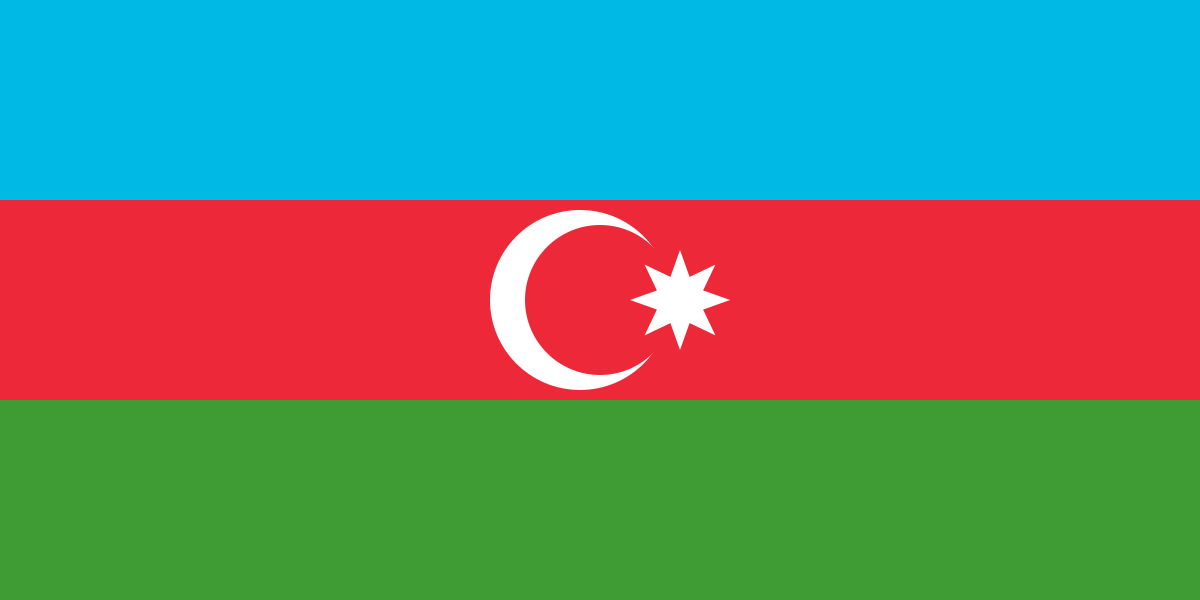
No weapons of mass destruction or related delivery systems were located on the territory of Azerbaijan--a nation with a Turkic and majority-Muslim population--when it regained its independence after the collapse of the Soviet Union in 1991. In spite of a long-standing conflict with neighboring Armenia over the disputed Nagorno-Karabakh enclave, Azerbaijan has not sought to develop WMD capabilities and is a signatory of a number of international accords, including the Nuclear Non-Proliferation Treaty (NPT), the Comprehensive Test Ban Treaty (CTBT), the Chemical Weapons Convention (CWC), and the Biological and Toxin Weapons Convention (BWC). Azerbaijan has cooperated with United States on
WMD nonproliferation and defense activities and signed a corresponding agreement
on 28 September 1999.
на русском (in Russian)
There are no known nuclear reactors, research facilities, or uranium mines
on the territory of Azerbaijan. However, there is a large quantity of
radioactive waste stored at the Izotop Industrial Complex and in other
locations.
Azerbaijan is a signatory to the Minsk Accord, the Nuclear
Non-Proliferation Treaty, the Comprehensive Test Ban Treaty, and is a member of
the International Atomic Energy Agency.
NATO and Azerbaijan are working
together to detect and render harmless lost or neglected sources of radiation.
Areas of concern include the Gabala radar station, military factories, dumps,
and hospitals. The aim is to prevent dealers and terrorists from getting their
hands on radioactive waste.[1]
According to news reports in 2007, Baku is
considering the possibility of building a nuclear power plant.[2] According to
Makhmud Kerimov, president of the Azerbaijani National Academy of Sciences,
Azerbaijan plans to build a nuclear research center beginning in 2009 and,
possibly in the future, a nuclear power plant.[3]
[1] "NATO Projects
Designed to Bring Azerbaijan Closer to Alliance," BBC Monitoring International
Reports, 21 December 2006; in Lexis-Nexis Academic Universe,
http://lexis-nexis.com.
[2] "Azerbaijan Wants to Build Nuclear Power
Station," BBC Monitoring International Reports, 13 April 2007; in Lexis-Nexis
Academic Universe, http://lexis-nexis.com.
[3] "V Azerbaydzhane budyet
postroyen atomnyy issledovatelskiy tsentr," [A Nuclear Research Center Will be
Built in Azerbaijan], Day.az Ekonomika, 26 September 2007.
See Azerbaijan Nuclear Profile
There is no evidence to suggest that Baku possesses or is pursuing
biological weapons capabilities. On 6 June 2005, the U.S. Department of Defense
and the Cabinet of Ministers of the Republic of Azerbaijan signed an
Agreement Concerning Cooperation in the Area of Prevention of Proliferation
of Technology, Pathogens and Expertise that could be Used in the Development of
Biological Weapons. Under this agreement, Baku and Washington work together
to improve security and safety at the Azerbaijan central pathogen health
laboratory and at the Republican Anti-Plague Station in Baku. In September 2005,
124 samples of 62 unique strains of causative agents of plague, anthrax,
cholera, and other dangerous diseases were transported from Baku to the U.S.
Armed Forces Institute of Pathology in Washington, DC, where the strains will be
studied jointly by U.S. Department of Defense and Azerbaijan medical
researchers. The strains had been collected over many years from environmental,
human, and animal sources in Azerbaijan and will be used to identify pathogens
in possible future outbreaks. At present, under the Biological Threat Reduction
Program (BTRP), the U.S. DOD through its contractor Raytheon Technical Services
Company continued to renovate training space and enhance site security at the
Anti-Plague Station and renovate the interim diagnostic laboratory at the
Republican Veterinary Laboratory in Baku.[1] Azerbaijan acceded to the
Biological and Toxin Weapons Convention in February 2004.
[1] Cooperative
Threat Reduction Annual Report to Congress Fiscal Year 2008 Cooperative Threat
Reduction Annual Report to Congress Fiscal Year 2008 Information Cutoff Date:
December 31, 2006,
<http://www.dtra.mil/documents/oe/ctr/FY08%20CTR%20
Annual%20Report%20to%20Congress.pdf>.
Azerbaijan is a founding member of the Organization for the Prohibition of Chemical Weapons (OPCW) and a signatory to the Chemical Weapons Convention. There is no evidence to suggest that Baku is pursuing a chemical weapons capability.
The Russian Daryal type Radar Station in Gabala, also known as Lyaki, continues to operate as an early warning system to detect missiles launched towards the former USSR from the south. The site does not officially have the status of a Russian military facility, but continues to be operated by Russian military personnel.
 |
| |
Updated April 2008 |
 |